



The story of Brancusi’s ‘Kiss’ from the grave of a mysterious Russian woman in Montparnasse cemetery
One of the versions of Constantin Brancusi’s famous “Kiss”, installed 115 years ago on the grave of a mysterious Russian suicide bomber in the Montparnasse cemetery, then the subject of strange erotic fantasies, has been at the center of an unprecedented legal battle for almost 20 years, initiated by the Ukrainian family of the deceased. A saga so improbable it even inspired a novel.
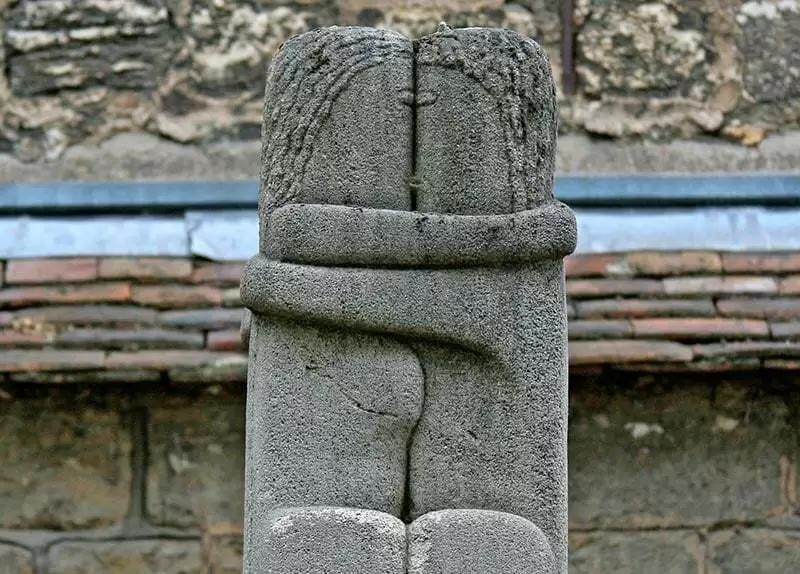
The embrace of two lovers is so profound that the two lovers form a single monolith with clear lines. This poignant work, Le Baiser (1907) by the French-Romanian sculptor Constantin Brâncuși (1876-1957), exists in some 40 versions. While the latter can generally be admired in museums, one of them is in an unexpected place: atop the star of a tomb in the Montparnasse cemetery in Paris’s 14th arrondissement. Strange through and through, her story begins with a tragic event. On a rainy day in late November 1910, a 23-year-old Russian medical student named Tatiana (called Tania) Rachevskaya was found hanged in her room on the Boulevard Port-Royal. Who was this mysterious young woman, said to be related to the writer Tolstoy?
“She was in prison, then she went to Paris and enrolled in medical school,” the writer Ilya Ehrenbourg wrote in 1962 in an autobiographical novel, Les Années et les hommes. Once in the City of Lights, the young immigrant fell passionately in love with a Romanian-born doctor, Solomon Marbais, who became her lover. Was it because of her heartbreak that she took her own life? Either way, this doctor will pay tribute to her with a unique gesture.
The work of a young sculptor still unknown
The man meets a talented young sculptor, one Constantin Brâncuși. Of Romanian origin like himself, this artist, still unknown to the public, worked as an apprentice in Auguste Rodin’s studio. To the family of the deceased, who wished to erect an unusual funeral monument, the bereaved lover suggested that they purchase a sculpture his friend had just finished: a 90-centimeter-high version of the Kiss, which the young woman’s relatives bought for 200 francs and placed on her grave, after having engraved these simple words on the work: “Dear beloved”.
Like many avant-garde artists of his time (such as Picasso and Modigliani), Brancusi was inspired by the pure forms of primitive art (African, Oceanic, pre-Columbian sculptures…) and by Cycladic art. Characterized by a schematic and extremely symmetrical pattern of faces and bodies, this “Kiss” has an archaic and totemic dimension – a ritualistic aspect which, combined with its grey shape and colour, similar to that of a simple stone star, allows it to blend into the decor of a Parisian cemetery.
A tomb turned erotic
For almost a century, the work was not particularly noticed. But in 2000, it was mentioned in “Kamikaze”, the fourth and final volume of writer Marc-Édouard Nabe’s intimate diary. In a scandalous passage, he recounts his sexual adventures with a girlfriend near the sculpture. From then on, the stele, with its new erotic reputation, became a popular meeting place for lovers.
Another event, this time a financial one, will further increase his fame. On May 4, 2005 in New York, a marble sculpture by Brâncuși, “L’Oiseau dans l’espace” (The Bird in Space), sold at Christie’s for an astronomical $27.5 million, making it the most expensive sculpture ever sold. Sensing a good bargain, the Parisian art dealer Guillaume Duhamel, who knew the “Kiss” in Montparnasse Cemetery, hired a genealogist and managed to find six of Tanya’s descendants, unwitting owners of the funerary monument and perpetual concession holders. The gallerist then goes to their home in Ukraine and offers to sell the sculpture at auction. The tomb will settle for a copy.
The legal battle of the deceased’s descendants
Attracted by the millions at stake, the descendants are claiming their rights at Paris City Hall, just six weeks after the sale of the painting “L’Oiseau dans l’espace”. Through Duhamel and the Millon auction house, they are also applying to the Ministry of Culture for a certificate of abandonment, which is required to sell the work to a foreign buyer or one who wants to remove it from France. But the minister, Renaud Donnedieu de Vabres, is firmly opposed. To prevent “The Kiss” from going abroad, he classified this latest national treasure, then listed the entire tomb as a historic monument in 2010 as a “building by its very nature” – meaning that the tomb and the work form an indivisible whole.
Strange legal sagas
Refusing to accept the outcome, Tanya’s descendants challenged the decision. On April 12, 2018, the Paris Administrative Court rejected their request again. Still hoping to recover the sculpture one day, the disheartened family installed a ventilated wooden enclosure around it, making it impossible to admire, to protect it from outdoor display, vandalism or theft… All this under the watchful eye of two cameras belonging to the Paris City Hall, permanently focused on the tomb.
“The Kiss is not the only work of art to adorn a tomb. In the same cemetery, you can also find César’s centaur on his tomb, or Niki de Saint Phalle’s colorful mosaic cat on that of her friend Ricardo Menon. But until now, none had been the subject of a legal battle to be claimed. This surreal conflict inspired writer Sophie Brocas’ novel The Kiss (2019), published by Julliard. Blending fiction and reality, the author creates the character of a young Parisian lawyer who tries to protect the sculpture from the greed of the deceased woman’s descendants.
But the real story is far from over. On December 17, 2020, an administrative appeals court ruling ruled in the family’s favor, ruling that “The Kiss”, because it was created before the monument, could finally be removed from the pedestal and moved. Immediately, family representatives went to the cemetery to try to retrieve the statue. But when they arrived at the memorial, municipal officers already stationed there prevented them. Furious, the descendants demanded a bailiff to record the facts.
Decision
In early July 2021, the Conseil d’Etat (the highest administrative court in France), referred by the Ministry of Culture, issued a ruling contrary to that of the Court of Appeal. “The sculpture was acquired for the sole purpose of being affixed to the young woman’s grave, thus constituting an indivisible funerary monument,” it said. Therefore, the legality of the 2010 decision has been confirmed: this monument must be considered “immovable property by nature”, which authorizes the state to register it as a historical monument, without the owners’ consent or even compensation to them. This decision “recognizes the heritage value of funerary monuments and allows them to be protected,” the Paris City Hall said.
Since the record-breaking sale in 2005, Brancusi’s works have fetched increasingly large sums at auction. In 2017, “The Sleeping Muse” (1913) was bought for over 57 million dollars, and “Young Sophisticated Girl (Portrait of Nancy Cunard)” for 71 million dollars in 2018. With a romantic history, “The Kiss” in Montparnasse Cemetery could therefore sell for over €50 million. Fully aware of this, Tanya’s heirs have decided, as a last resort, to refer the case to the European Court of Human Rights (ECHR).
On November 16, 2023 (while a major Brâncuși retrospective was being prepared at the Centre Pompidou), the family received a devastating blow: the European Court of Human Rights (ECHR) declared their claims inadmissible. The reason? The limitation imposed on the plaintiffs’ property rights (by prohibiting them from separating the sculpture from the tomb) was simply a “regulation of the use of property” and not a “deprivation of property” that violated human rights. The “Kiss” therefore remained on its pedestal.