


INTERVIEW – Dan Perjovschi: I inject a little humor so that the truth becomes bearable
Dan Perjovschi, one of the most titled Romanian visual artists, with hundreds of projects realized in the country and abroad, talks in an interview with Curatorial about his career, about the first and the largest retrospective in Bucharest of his work, alongside that of Liei Perjovschi, who has been his partner for four decades.
“DRAFT for a joint retrospective“, hosted by ARCUB – Gabroveni until July 26, brings the practices of the two artists into dialogue: from Dan Perjovschi’s incisive drawings and mural interventions inspired by political current affairs and everyday details to Lia Perjovschi’s research projects, archiving and conceptual installations based on an interdisciplinary perspective on knowledge.
It is complemented by guided tours, programmed or spontaneous talks and presentations by Romanian and international guests.
Dan Perjovschi (b. 1961, Sibiu), internationally recognized for his incisive style, has exhibited in some of the most prestigious institutions and events of contemporary art: from MoMA New York, Tate Modern London, Centre Pompidou Paris, Moderna Museet Stockholm to Documenta Kassel, Venice Biennale, Istanbul Biennale, Sydney Biennale and Manifesta.
Between 1985 and 1990, he worked as a museographer at the Art Section of the Crisșurilor County Museum Oradea. In the first years after the fall of communism she worked at the youth (and later art) department of the Ministry of Culture and organized the first international exhibitions of the young art scene. Since 1990, he has been working at Revista 22. He started drawing “directly on architecture” in 1995 at Franklin Furnace in New York, his first famous project being in 1999 at the Venice Biennale, where he drew on the pavilion floor.
“Romania has progressed enormously, but it has remained a tragicomedy”, is Perjovschi’s conclusion about the years after 1989.
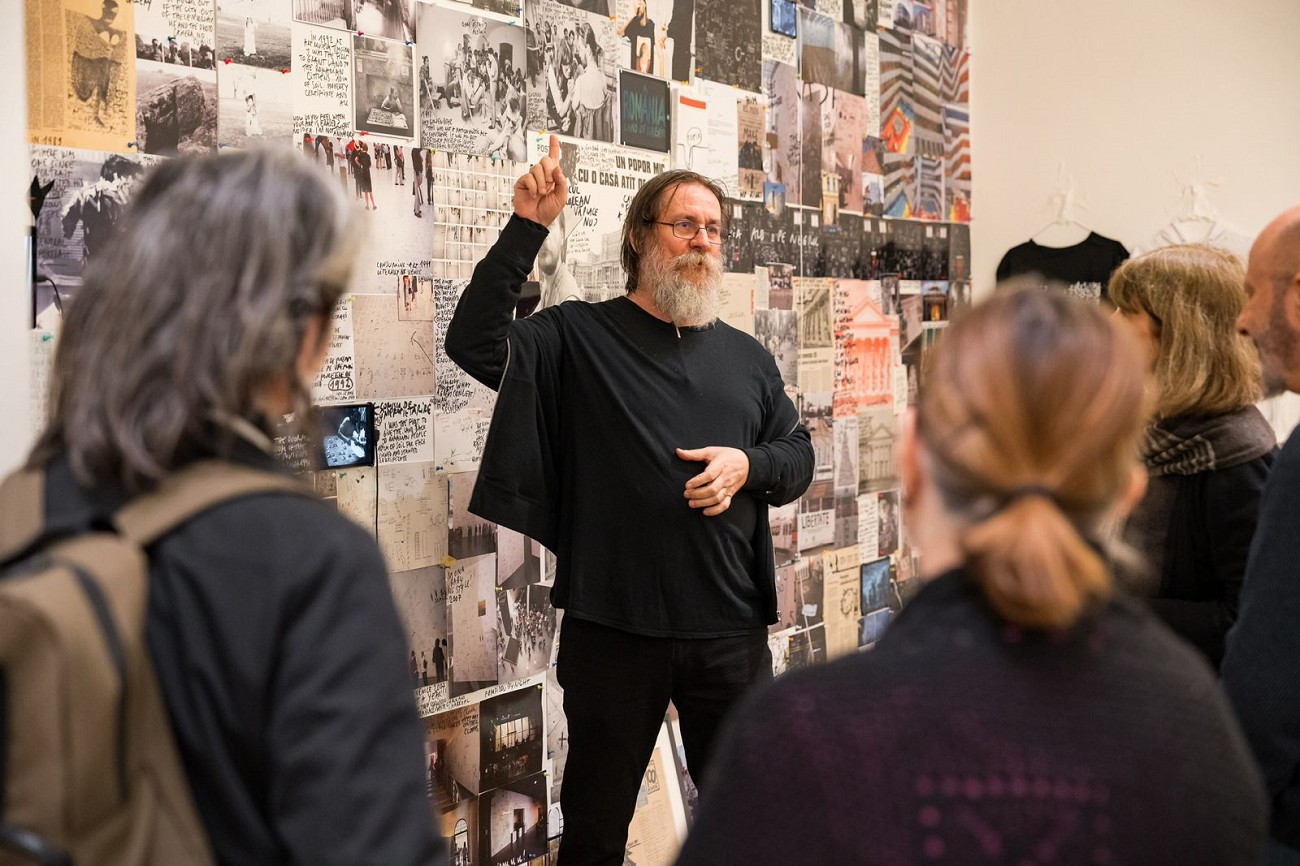
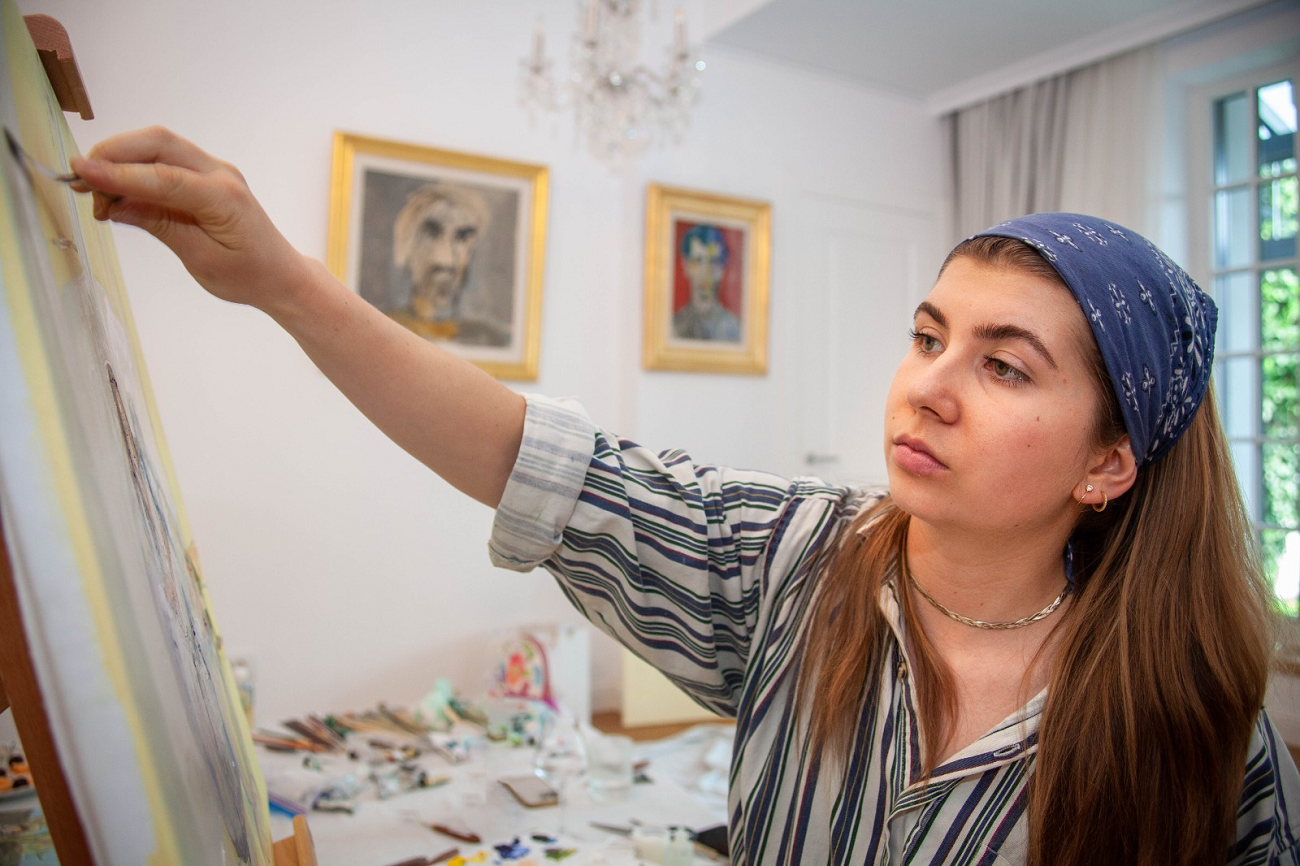
Dan Perjovschi, tour in the exhibition “DRAFT”; credit: ARCUB
How would you describe your beginnings in graphic design, in a social and political context radically different from today’s?
Dan Perjovschi: First of all, I finished painting at the “George Enescu” Conservatory in Iasi. Graphics or, better said, drawing was my escape from a school that didn’t do me much good. As soon as I finished painting I stopped painting.
One of the rooms of the retrospective is dedicated to Anthropograms, the series of drawings of little people, the literal people. From 1986 to 1990, I made sophisticated drawings of dozens of little people. I was fascinated by the masses… we, at that time, were trying to be individuals, although we were treated as masses.
The letter people adjusted the pattern after the Revolution, when I had less time and had to “produce” more, then in 1993 the video installation at Ex Oriente Lux, the first big video art exhibition in Romania, and in 1995 I turned them into performance art when I drew with the public the whole Franklin Furnace alternative space in New York, from floor to ceiling with pencil on the wall. Thousands and thousands of little men.
After 2005, I started to weave the little men out of wire and the anthropograms became mobile sculptures.
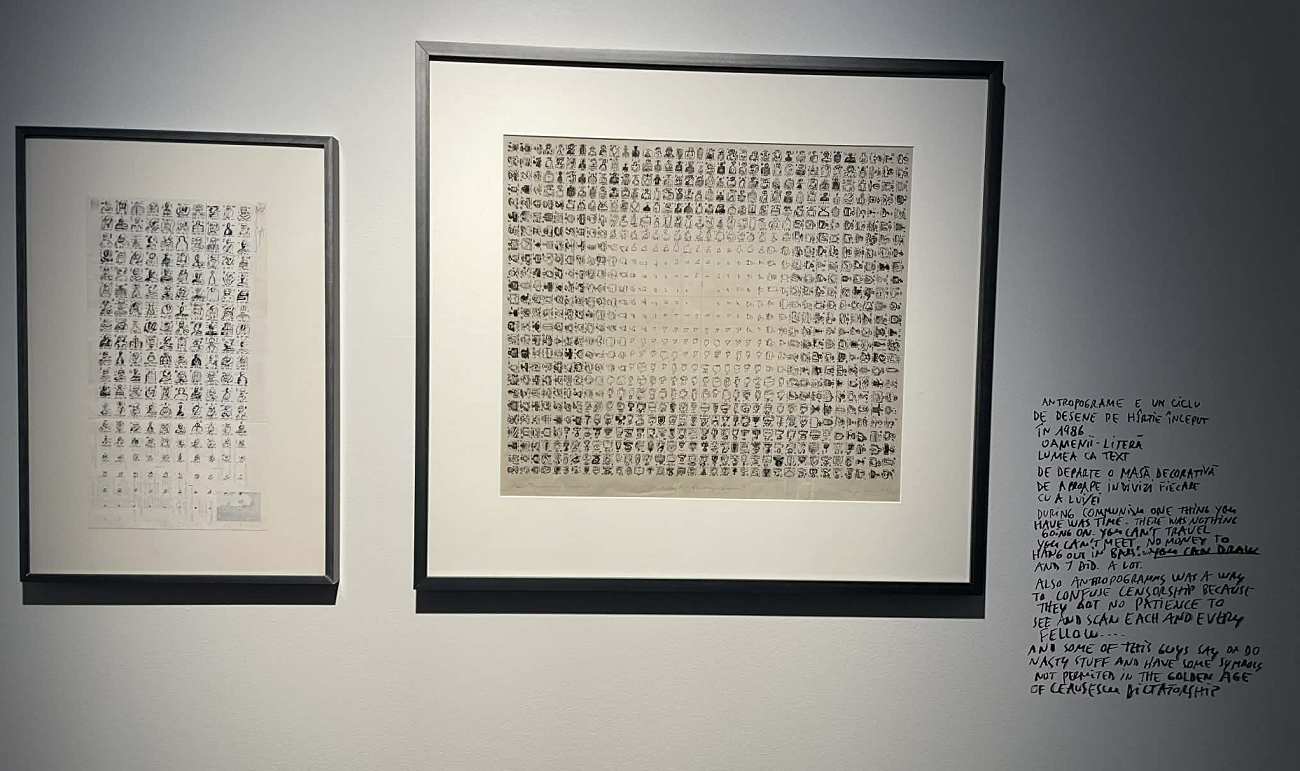
Anthropograms, by Dan Perjovschi; credit: Curatorial
What has stayed the same in the way you draw – especially from an interior point of view?
Dan Perjovschi: In the ’90s I started to publish drawings in Revista 22, the first independent weekly magazine founded after the Revolution and edited by a think tank of intellectuals and former dissidents. In other words, a political publication. Political, social, cultural. In 36 years, I have developed a media metabolism to extract from a text of analysis an image or several images that summarize the text in a few lines.
In the beginning, I used to draw more drawing – i.e. hatching, modulated lines, etc. Now, the drawing is simple, direct and biting. But with humor. I inject a little humor to make the truth bearable.
In 36 years, my drawing has changed enormously. It may not be noticeable in recent years, but it is constantly adapting and changing. From two square inches in my notebook to three and a half feet on the walls of museums, and the pen line has become the 2-inch thick marker line. And sometimes nci is no longer drawing, but text. A word.
Interior? I have always looked at the world with naivety and admiration. I always wanted to understand, I was pained by the stupidities and injustices of humanity, I was energized by the achievements and progress of humanity. I stayed the same, but now I know much more. I’ve re-centered many of the drawings that were going to the right or to the left… I’ve become wiser.
What is troubling you today, as an artist and as a citizen?
Dan Perjovschi: Almost everything. I can’t believe that in the 21st century cities are still being wiped off the face of the earth and world leaders are using hatred and grobbianism as a means to rule. I don’t understand why anyone would want to be the only one among poor and hopeless fellow citizens. What great achievement is that? Why not wish everyone else to do well? Why not want a society where everyone has a place? How is racism still possible? Intolerance? Bullying?
What does “engaged art” mean for you today compared to the 90s?
Dan Perjovschi: In the ’90s it was simple – the bad guys were the communists and former communists, the cultural conservatives who had swallowed the key to the locked door. Now everyone can be stupid and retrograde or, on the contrary, open and progressive. Lia and I had invented the term dissident from dizzy in English, because we didn’t know who to oppose.
I don’t make engaged art per se, nor am I an activist artist. I support various projects and protests and I don’t shy away from saying or writing directly what I find wrong and bad in society, culture, politics. But yes, I have the freedom to say, I also have the responsibility to say…
I live in a complex age, which is not like in my black and white drawings, but infinitely nuanced. And I have to take it into account.
My intention is not to remain stuck in one camp, but to support and join any artistic, ecological, associative, charitable endeavor that, in my opinion, brings good to society. That’s why I make drawings for Rosia Montana, the hospital built by Dăruiește viață, the AltReal Residence in Vadu Oii, In Context in Slanic, Save the IOR Park, Malmaison etc… but also for Art at the Time like This in New York and projects in the public space in Crete and activist exhibitions in Belgrade.
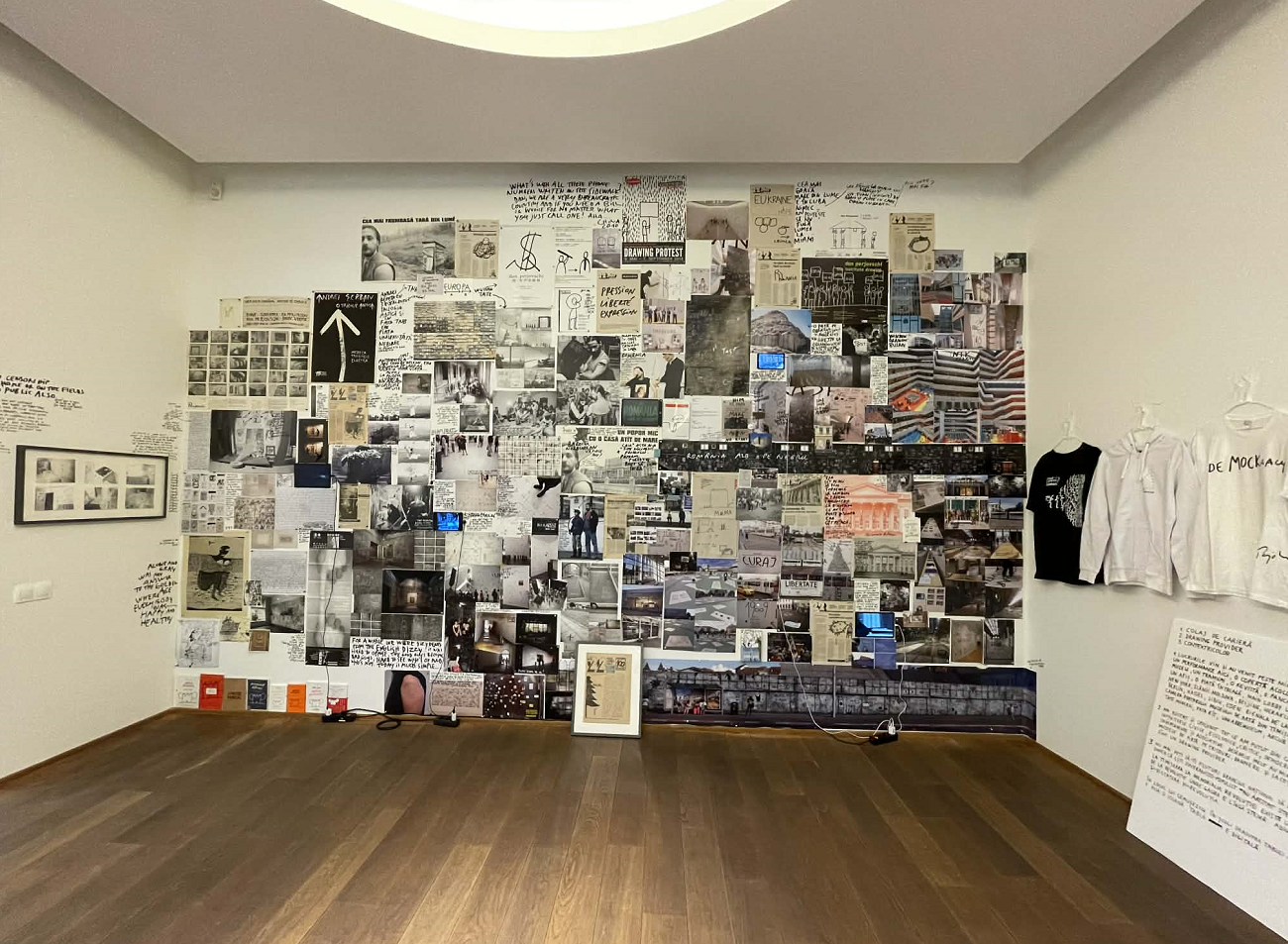
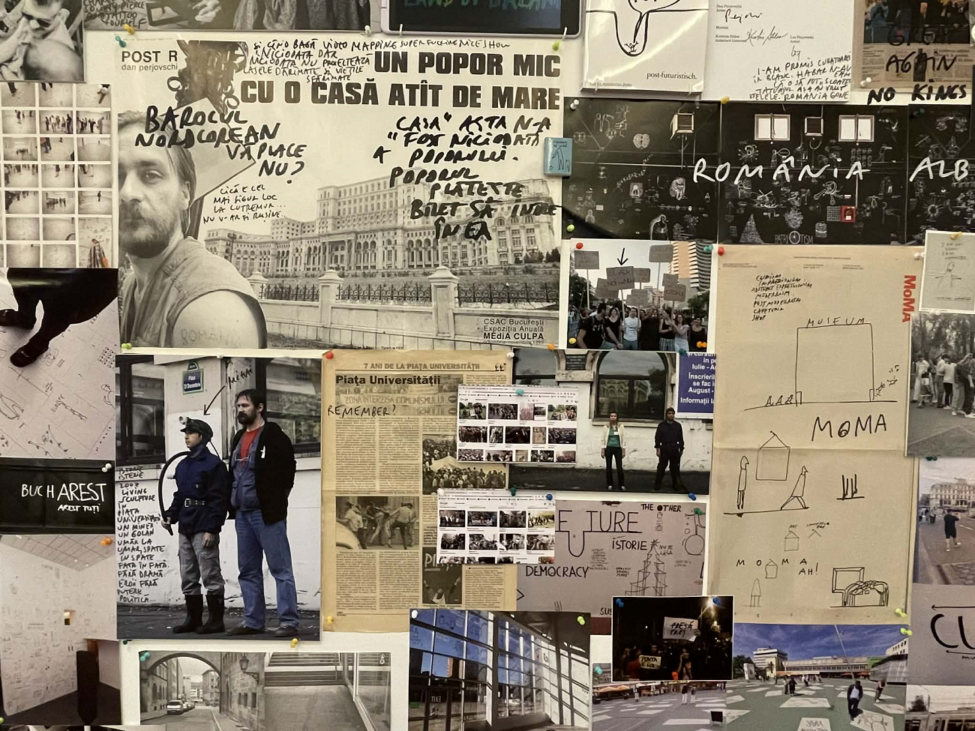
Collage Dan Perjovschi, in the exhibition “DRAFT”; credit: Curatorial
Do you think art still has real power to influence social change?
Dan Perjovschi: Yes. I am an example. Who goes to the “DRAFT” exhibition will see a wall of t-shirts representing various social, charitable, artistic or progressive projects in Romania and beyond. They all have my drawings. All the designs were gifts, meaning I took zero lei for making or subsequently selling them. When I am asked if I have changed the world, I answer that I don’t know, but they, those causes, have certainly changed it. And I’ve been there. A drawing provider.
And I, as an artist who was not on that list of citizens who had to be saved at Covid, that is me – the artist that the state does not consider indispensable – I can give my work, I can give my time and I can help society as a whole. And I’m not retiring at 45 like other citizens. I don’t have a pension and I don’t have a salary… I’d like the readers to get that into their heads. Artists work hard for little money and with nerves as big as a house all the time.
How has the Romanian public changed in its relationship with critical art?
Dan Perjovschi: If you go by how many people come to the guided tours we do, it’s changed. We – Lia and I – don’t do classical exhibitions. We don’t have paintings. We don’t decorate living rooms and we don’t consider the auction price the purpose of our art. We are woven into the fabric of global-local society and we care. We do our best to make it better and more logical. And the world, here and elsewhere, seems to be reacting, that, look, we’re not keeping up with demand.
What do you consider your most important contribution to the public space?
Dan Perjovschi: For 36 years, I have been drawing weekly/bi-monthly in Revista 22 București the realities of the global and local world in which I live. For 20 years, I have been supporting social, environmental, charitable, activist and cultural causes through my drawings. For 15 years, I founded the horizontal newspaper Sibiu. It’s 30×4 meters. It is an art project in public space. There I collect the drawings I make all over the world for my fellow citizens to see and, in addition, I question Romanian society in general and the city of Sibiu in particular.
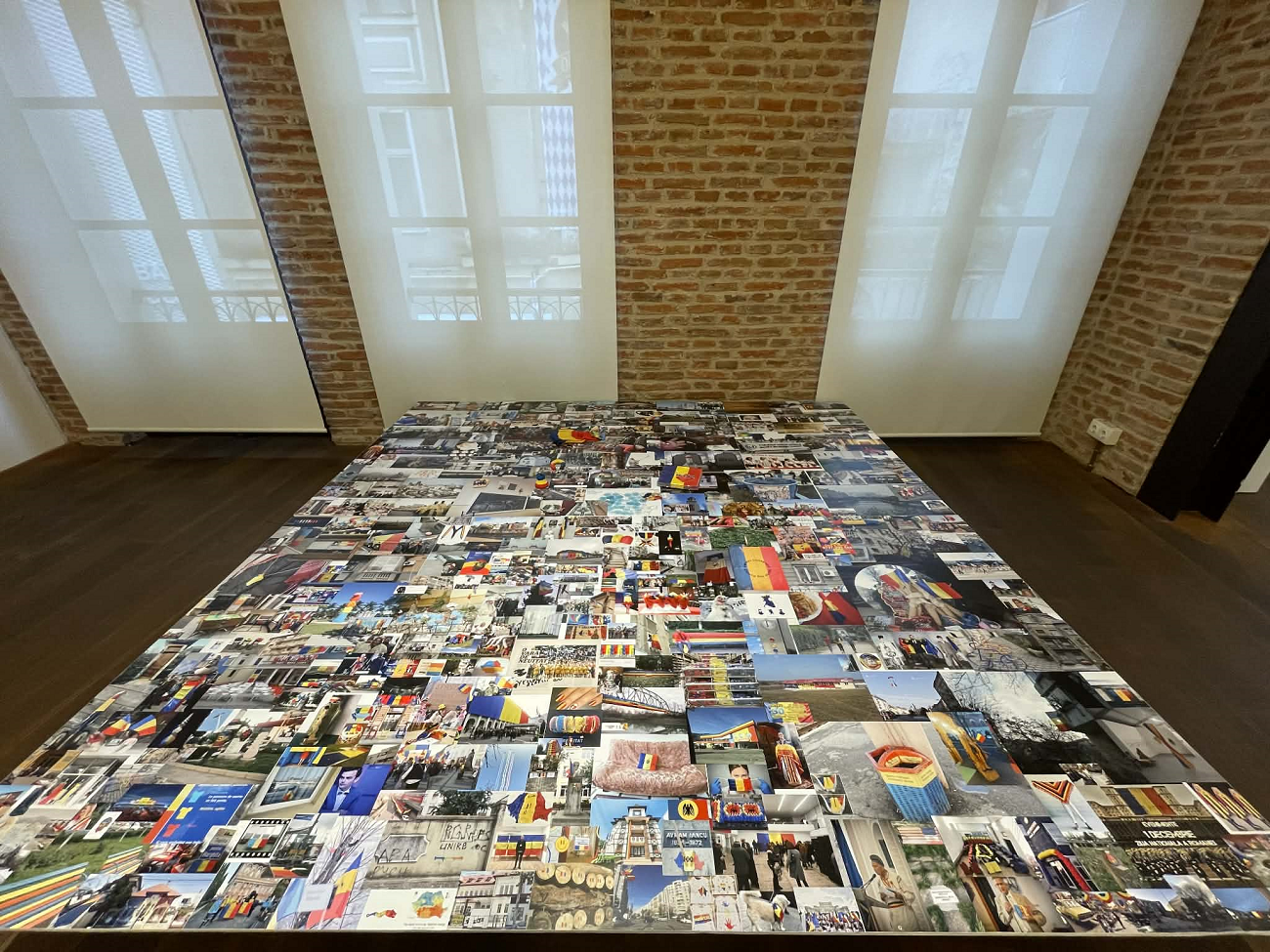
Anthology of the tricolor, collage by Dan Perjovschi in “DRAFT”; credit: Curatorial
What are the current social causes that concern you most?
Dan Perjovschi: Flagrant inequalities, nature-ecology, access to culture.
Do you think digital has amplified or diluted the impact of activist art?
Dan Perjovschi: So and so. It’s easier to distribute. It can get lost in the daily flood of information.
What themes do you think will become central to activist art in the coming years?
Dan Perjovschi: Water, poverty.
How do you see the role of the artist in an increasingly polarized society?
Dan Perjovschi: As a mediator. As someone who can say NO. The one who puts the dot on the i.
If you were to look at all your work as a kind of archive, what kind of history does it tell about Romania after 1989?
Dan Perjovschi: Romania has progressed enormously, but it remains a tragicomedy.