



Bernard Frize, the artist who defied the trend and painted ceaselessly / photo gallery
French painter Bernard Frize, the protagonist of an unprecedented exhibition in Eastern Europe, hosted by MARe/ Museum of Recent Art in Bucharest until August 16, brings a provocative perspective to the Romanian artistic landscape.
After exhibiting in cities such as Tokyo, Seoul, Shanghai, Hong Kong, Los Angeles, London and Paris, his visual universe has now come to Bucharest. The exhibition brings together more than 40 large-scale works. On display are works that Bernard Frize produced between 1978 and 2025, but this is not a retrospective, as Gregory Lang, the museum’s artistic director and curator of the exhibition, tells Curatorial. Rather, it is a rare presentation of works from each period that the artist keeps in his own storehouse.
“I wanted to present works that are very important to me and that are not necessarily the most sought-after on the market.”
For the exhibition at MARe, the curator collaborated with the Viennese gallery Schwarzwälder, who provided assistance, and was assisted by Elena Stanciu.
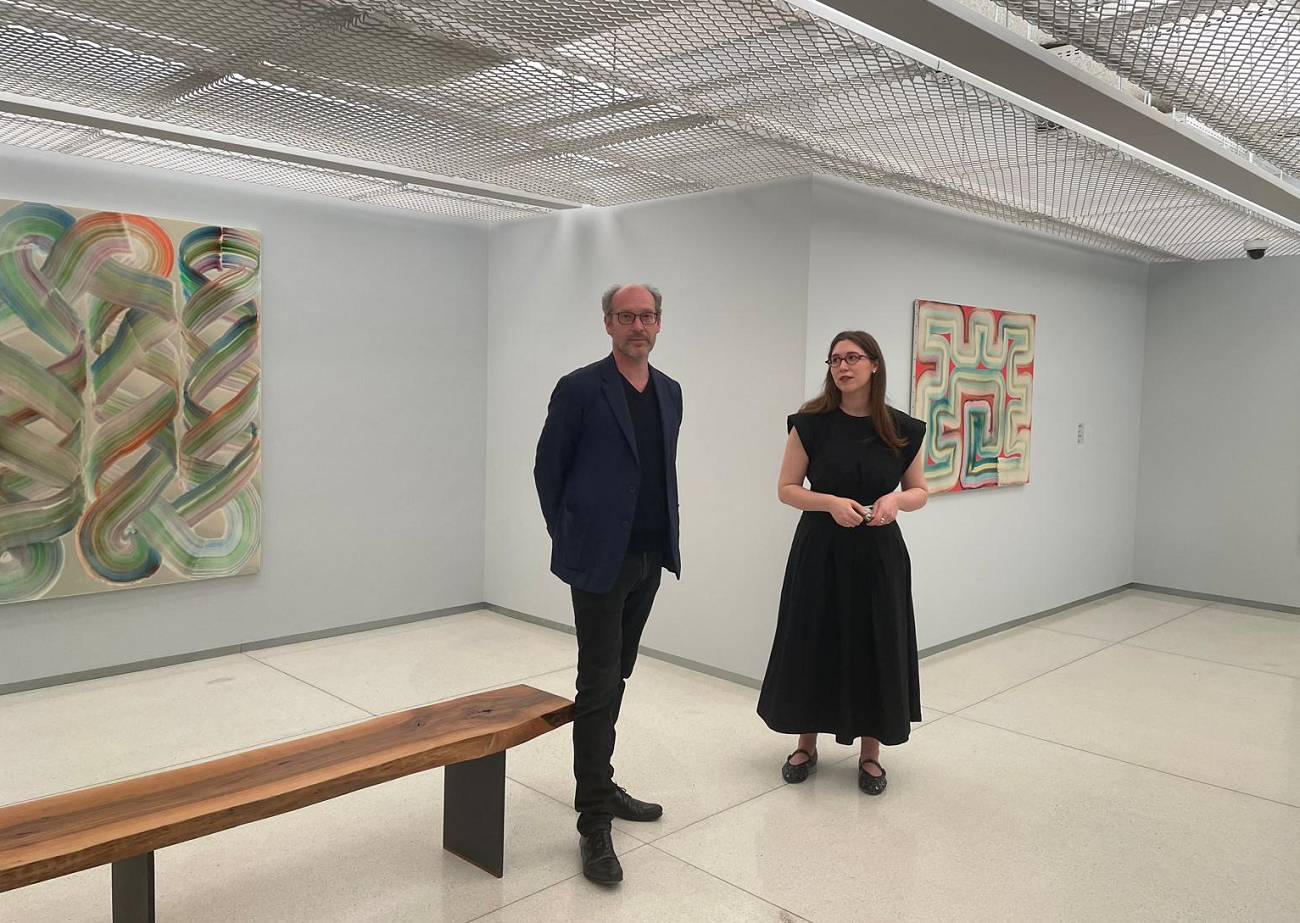
Gregory Lang and Elena Stanciu, in the exhibition Bernard Frize @ MARe; curatorial
Control that gives freedom
A rigorous artist, very demanding, in a way also very obsessive, but in everything he does, Frize actually focuses on setting rules for himself. “It’s also about control, but through that aspect of control, there’s another very important aspect: it gives him a lot of freedom and also allows him to be very playful and to let loose at a certain point.”
Bernard Frize makes a kind of puzzle, “a board game with strict rules”, as Lang says, and in this sense, his creation “is a minimalist work of art, meant to show that it is not an expressive figurative painting, as we usually see in Romania”.
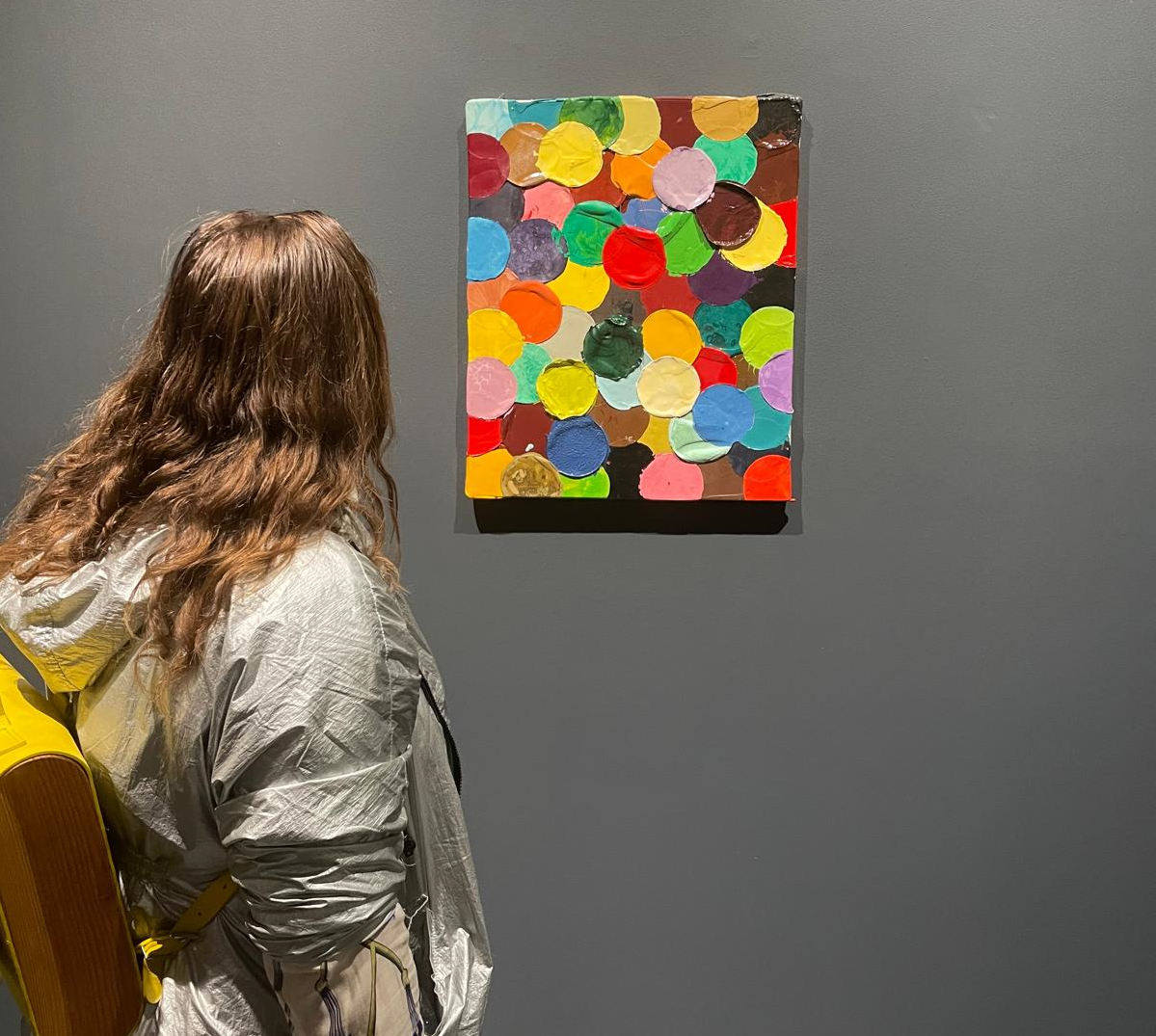
Bernard Frize @ MARe; curatorial
Variations in painting protocols
The intention was to invite an artist who makes completely different works.
“What I wanted to show are all the possible variations that these protocols offer, and to show the variety, the complexity and all the nuances that this painting can bring, and also how important the idea of repetition of movement is.”
An artist with this kind of technique can make the painting, the way of realizing it, a character of creation.
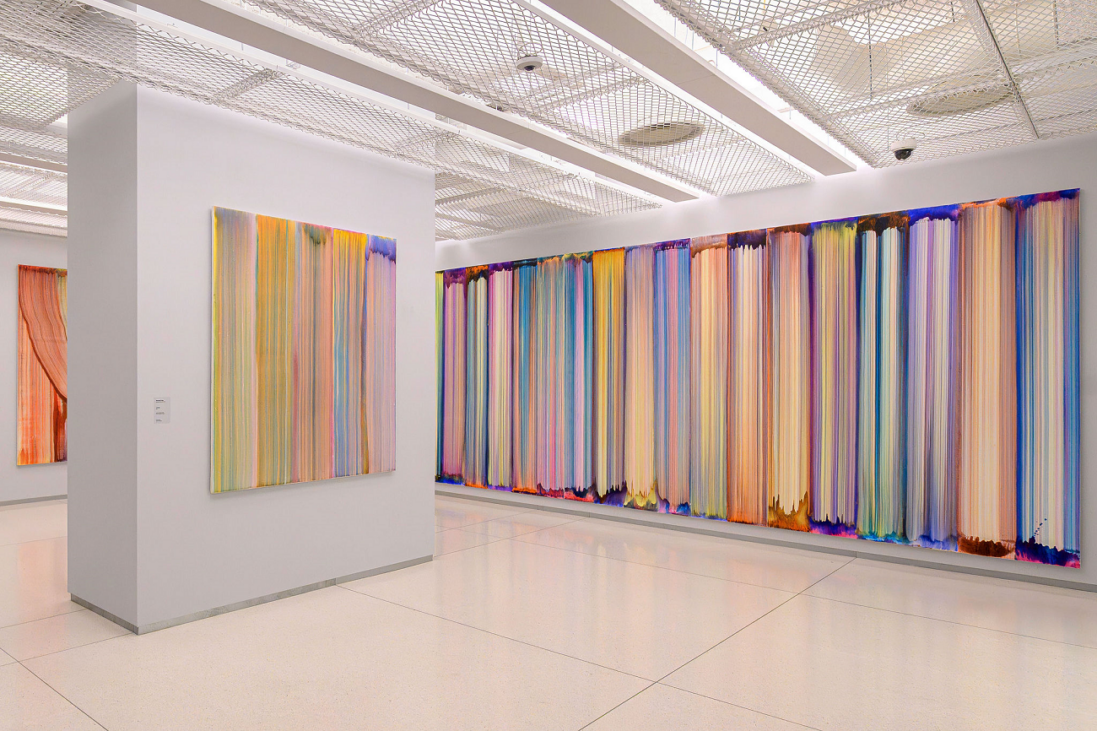
With thick strokes, even 20 centimeters thick, with different colors that intertwine, Frize captures the attention, provokes play and curiosity. With series of works painted horizontally, then leaving the paint to flow onto the canvas, with paintings created collaboratively, he stirs the imagination, always leaving room for dynamism, for a third dimension.
Frize uses stencils, and even these show the evolution of his art. Creations that absorb light and others that reflect it.
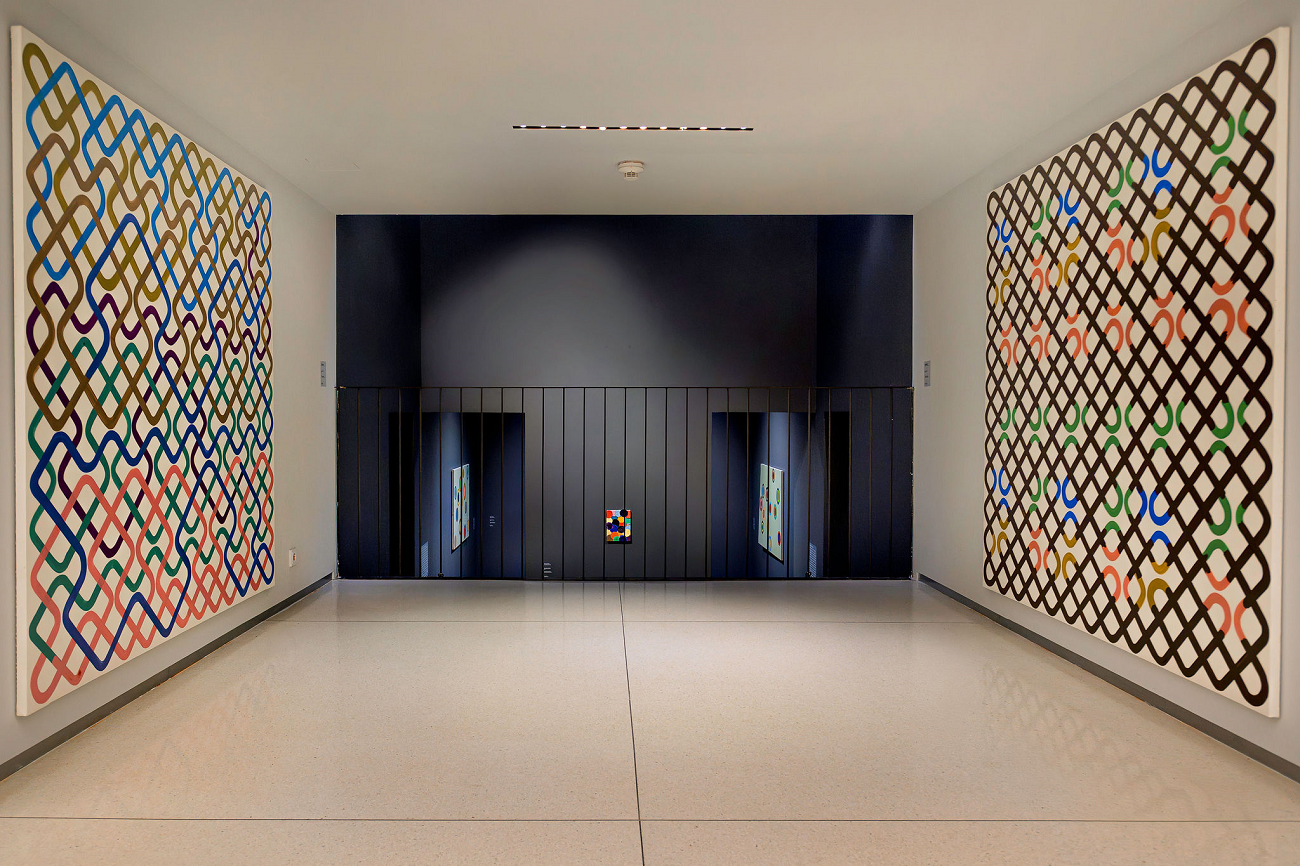
Bernard Frize, Suite à treize N°1&2; credit: Doria Drăgușin
Ideas from the constraints generated by the use of colors
Bernard Frize was involved in the selection process for the Bucharest exhibition, but to a lesser extent than his most recent show at the Pompidou.
“At his last show at the Pompidou, the approach was random, so he chose one work, but I focused more on presenting series and point of view; he probably would have preferred a more random selection, or he would have said to me, ‘You already have one of these, you don’t need two,'” Lang says.
The exhibition is complemented with quotes. The artist has said from the outset that he is not very fond of commenting and talking about his work. For this reason, the curatorial team decided to use texts.
“My palette is a table on wheels. About fifty glass jars contain the colors. I prepare them about once a week. Preparing fifty colors is an ambiguous exercise. On the one hand, because they exist only in relation to one another, and conversely, when many are mixed, each loses its capacity to be remarkable or autonomous. Why shouldn’t I paint a few pictures with them, before the jars are empty? (…) I use a lot of brushes: their size, their tuft, the softness of the brushes are all essential tools in painting. Sometimes I get ideas from the constraint of using them,” says the artist.
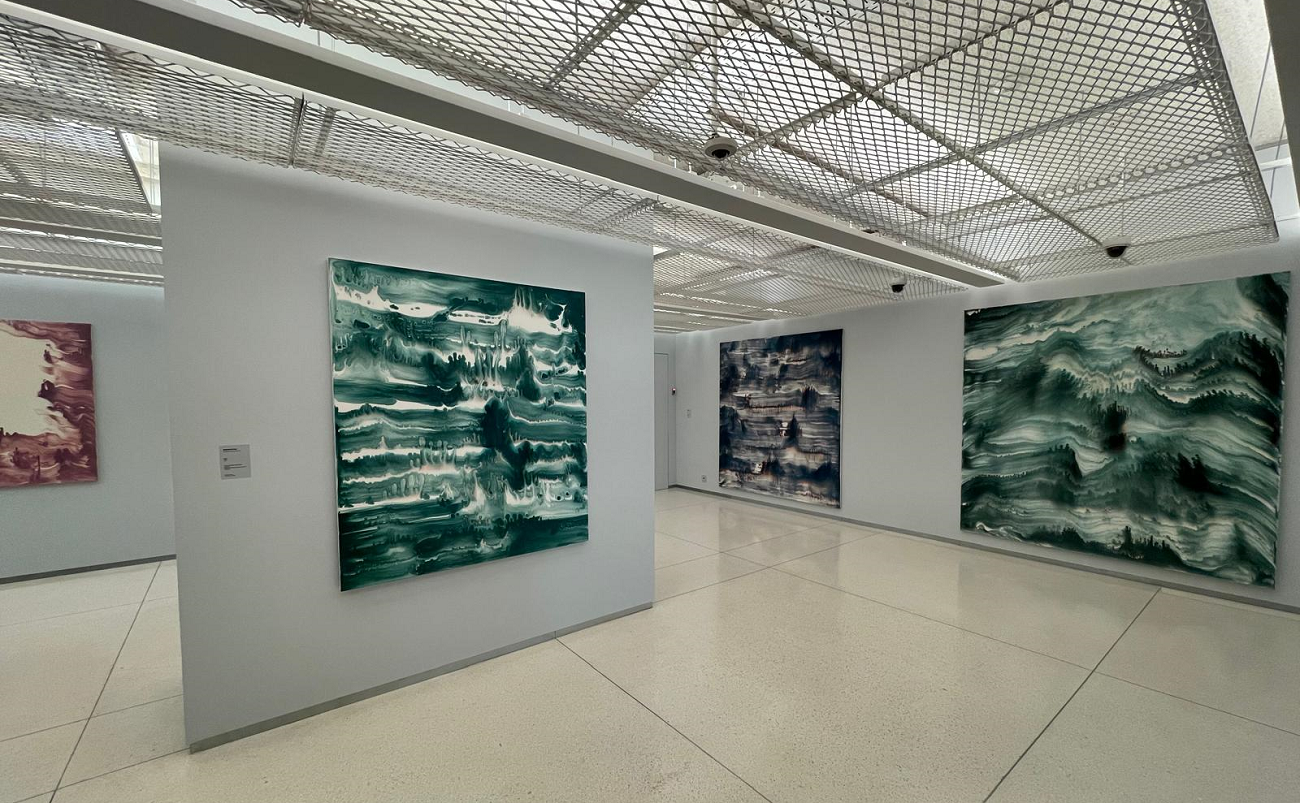
Bernard Frize @ MARe; curatorial
The 1990s and consistency in painting
On how relevant Frize’s experimental approach is today in an artistic context often dominated by digital imagery and explicit narrative, Lang says: “I think it’s important today because we have a resurgence of painting. During the period when he was creating his core body of work, the 1980s and 1990s, very few artists had remained loyal and were determined to continue their work. Painting was no longer successful in the Western world, so sculpture, installation, video and performance with a strict conceptual approach were popular. Frize continued even when it was very difficult to have an exhibition in institutions. And today his consistency over the years is important.”
Bernard Frize, born in 1949 in Saint-Mandé (France), began making the works for which he is known today in the late 1970s. His works are in the collections of the Tate Gallery in London, the Musée d’art moderne de la ville de Paris, the Museum of Contemporary Art in Los Angeles and the Kunstmuseum Basel, among others. Frize lives and works in Paris and Berlin.
Photo credit: MARe/ Doria Drăgușin; curatorial