



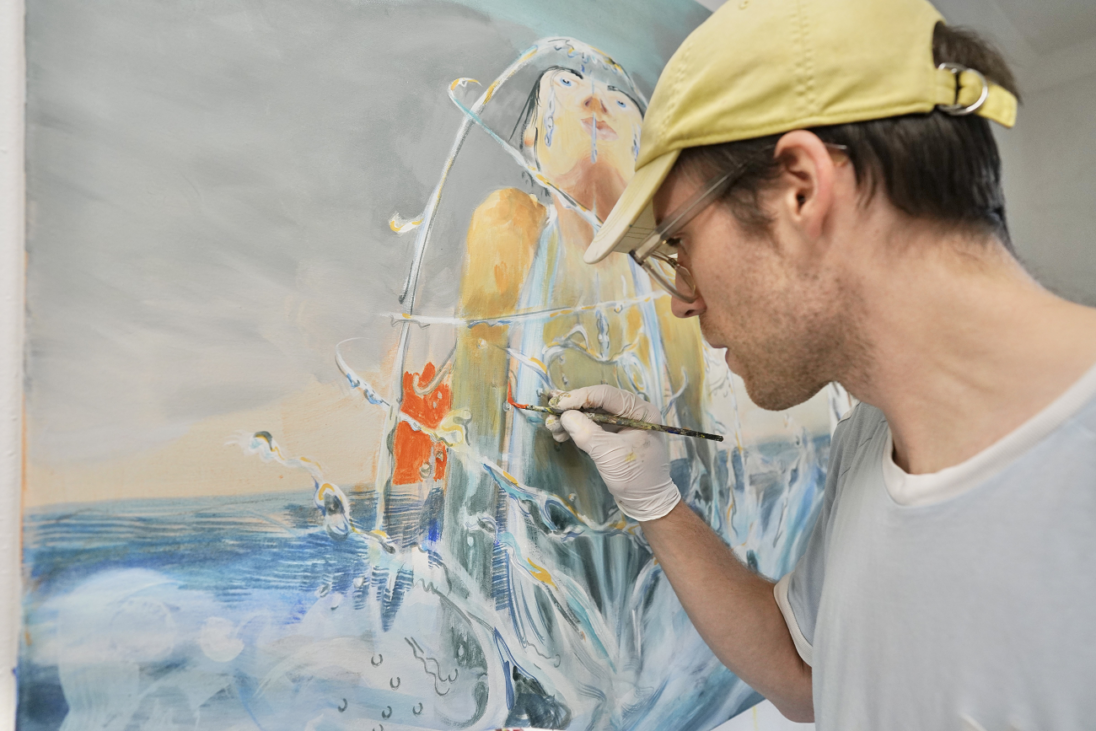
INTERVIEW – Jan-Luka Schmitz: Between Movement and Stillness, Painting as a Game of Imbalance
German artist Jan-Luka Schmitz paints portraits and creates figurative works that focus on the lives of his subjects, exploring the relationship between the body, perception, and the inner states of the human being. His practice combines a playful approach to painting with humor and an exploration of vulnerability, giving the viewer an active role.
Jan-Luka Schmitz (b. 1992, Düsseldorf) studied fine arts at the Kunstakademie Düsseldorf from 2012 to 2019, where he was a student in Prof. Andreas Schulze’s class; in 2019, he received his diploma (Akademiebrief) along with the title of Meisterschüler (MFA). Since 2025, he has held a position as a professor of painting at the same academy, a position he will hold until 2027.
His works have been exhibited in institutional venues and galleries in Germany, Italy, and France. Recent exhibitions include “Human First” at Whitewall Projects (Paris, 2025), “Supernature” at Palazzo Capris/Artuner (Turin, 2024), and “Coallision” at JVDW Gallery (Düsseldorf, 2025). His exhibition history includes the Kunsthalle Recklinghausen, the Städtische Galerie Lüdenscheid, the Kunstverein für die Rheinlande und Westfalen, the Akademie Galerie Düsseldorf, the K21 Kunstsammlung NRW, and the Kunstmuseum Solingen, among others. He is currently represented by Artuner.
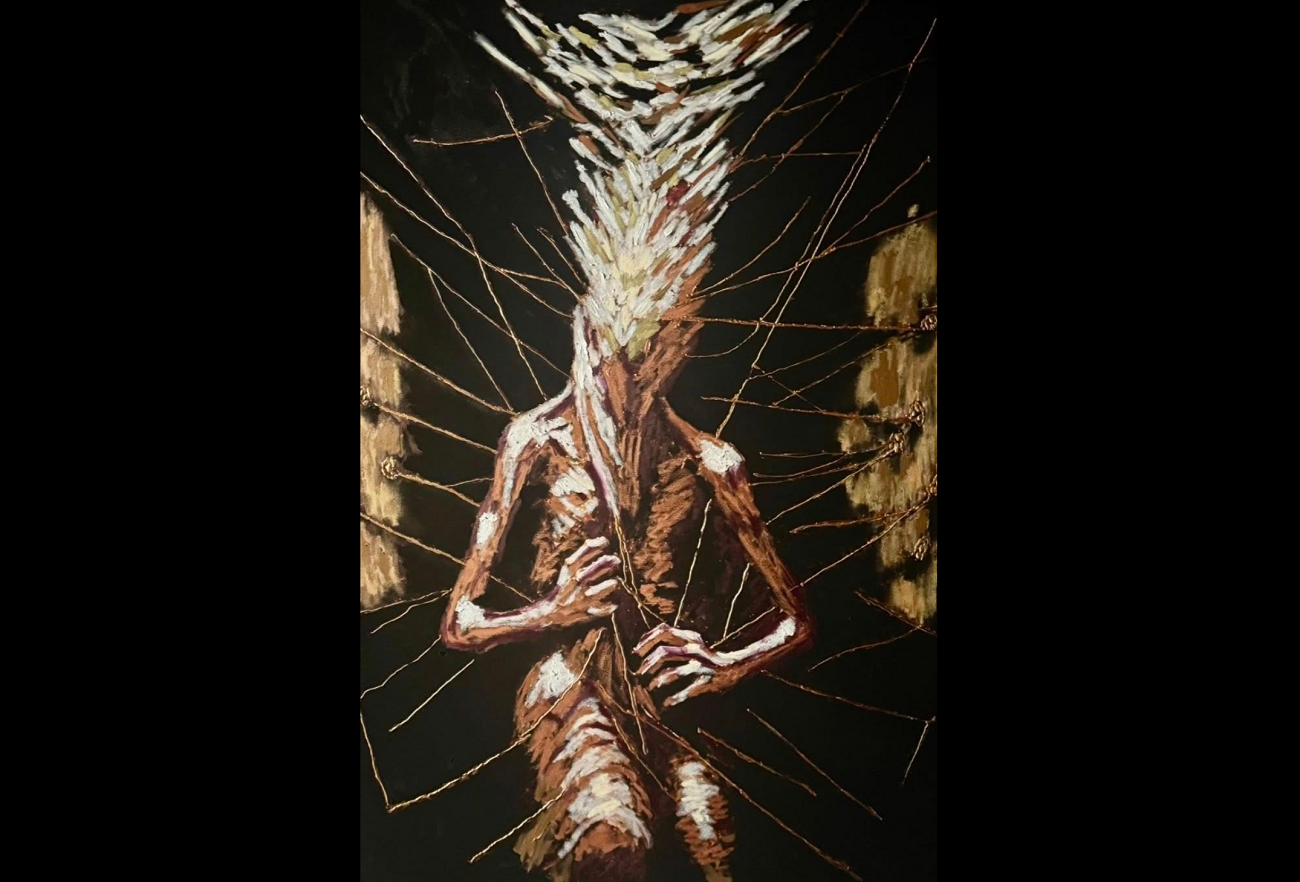
”What’s special about my portraits and figure depictions is the projective nature of the sitters, their doll-like quality: the focus is not on their inner lives, but rather on the external view of their situation—analogous to the viewer’s perspective on the artwork”, says Schmitz. ”Through my use of form and color, I construct a system of stability. A playful engagement with the medium always offers a way out of misery or highlights a humorous aspect. Central motifs are movement and paralysis—physical challenges—representative of inner states of being in the interplay of determination and destabilization, analogous to the painterly process.”
In an interview with Curatorial, the artist discusses his practice and the works he is presenting at the IOMO Gallery in Bucharest as part of the group exhibition“Celălalt/ The Other,” curated by Thom Oosterhof, which opened on the evening of October 29 and runs through December 18, Tuesday through Saturday, from 12:00 p.m. to 7:00 p.m.
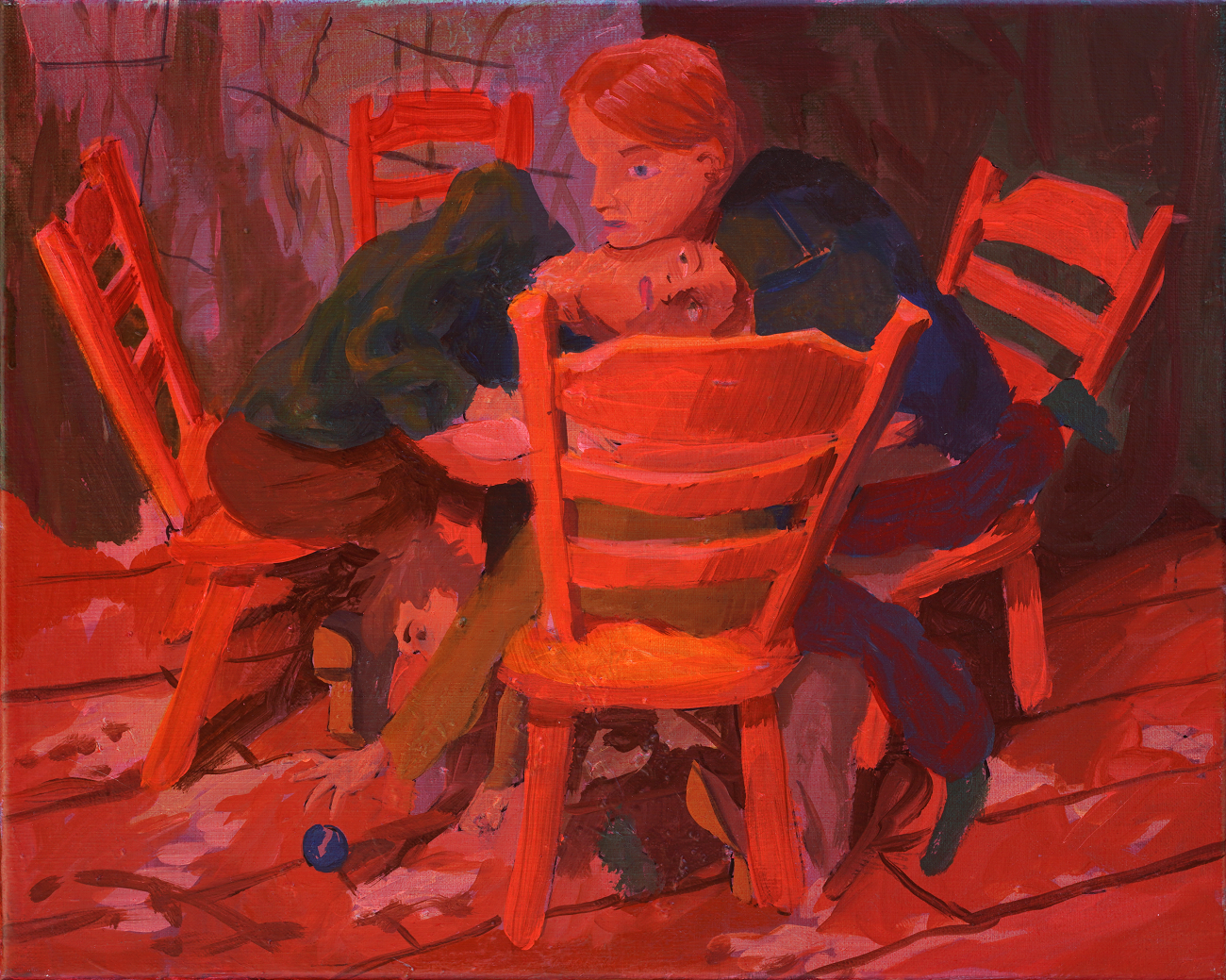
Jan-Luka Schmitz; IOMO
You describe your figures as having a doll-like quality. What attracts you to this way of representing them, and how does it influence the relationship between the viewer and the figure?
A doll or puppet must be activated. Presenting the characters in this way makes sense to me, as it reinforces my intention for the viewer to play out the scene in their mind, to move the figures in their imagination.
In your work, psychological states are suggested through physical experiences and situations pushed to their limits, rather than through facial expressions or explicit gestures. How do you transform a physical experience into emotional tension?
Most of my paintings incorporate an element of disturbance that the viewer feels compelled to “correct” in their mind. In my experience, this works best with these challenging situations.
Plus, color is perfect for creating nuance and tension, and to bring out something unexpected even in an activity that appears unspectacular at first.
Movement and paralysis, determination and destabilization are recurring themes in your practice. How are these oppositions reflected in your creative process and in the final composition?
For the way I work, the precise preliminary sketch and the application of paint are counterparts. The line has a sharpness, while the paint is fluid and has its own life. No matter how precise the sketch might be, applying the colors in the right spots brings a lot of chaos. So both is present all the time.
You mention that form and colour create a system of stability, while a playful approach to the medium of painting can introduce humour or offer a possible way out of a distressing situation. How do you find a balance between discomfort and playfulness?
Reality is packed with cruelty, injustice, stupidity. Partly, I am exploring on how we look at this reality in order to abstract images from it. But it doesn’t feel whole to only focus on the negative, so the layers of fun or relief are as important.
To what extent do the figures and situations in your paintings stem from observations of reality, and at what point do distortion, absurdity and imagination come into play?
Every painting has its root in something I saw somewhere in „real life“. But the means of painting are tempting to exaggerate or experiment on the subject. I don’t see these images as reflections of what’s there. I see them as images of how we could look at what’s there.
Some of your works are based on photographs. Do you consciously take photographs with the intention of turning them into paintings, or do certain snapshots reveal their potential as paintings only at a later stage?
Both is possible. My camera roll serves as a backup for when I need to fill a gap.
Very often I strike a pose myself and take a picture to construct the image. So photographs help me a lot, but I never transfer something 1:1.
What do the works presented in Bucharest have in common, and what distinguishes them in terms of atmosphere?
Over the past year, I’ve been studying the theme of light more than before. One of the images is quite bright, while the other is dark, red. I find it interesting how the sight of something in bright daylight can appear as mysterious as something in dim light.
Somehow, both radiate a sense of calm that transports a subtle sense of unrest at the same time. In both images the figures seem to be moved by an invisible force.
Your work has been exhibited in a variety of contexts in Germany, France and Italy. Have you noticed any differences in the way audiences interpret the images and tensions you create?
Talking in English often means that neither person in the conversation is speaking their native language. That leads to distilling the essence of what’s being said, or simplifying it.
When I speak German, the conversation quickly gets into the details and takes on this analytical tone, where you sometimes lose sight of the big picture a little bit.
To what extent does the context of a city or exhibition space influence the way you perceive your own work when it is presented in a new setting?
It’s always exciting to see the works installed under the circumstances of different wall dimensions, light and neighbouring artworks by other artists. That’s always a good test.
The city impacts very much the inner life of the people, and thus the perspective on the art, but in a more indirect way, I think.
What kind of feeling would you like to evoke at IOMO, and what impression do you think the exhibition will leave on the audience?
From what I saw the exhibition has quite a serious undertone. And I like the neighbourhood of these kind of works, and profit from this commitment. I think the audience will be impressed by the craftsmanship of my colleagues, as by the sensitivity of their selected works.